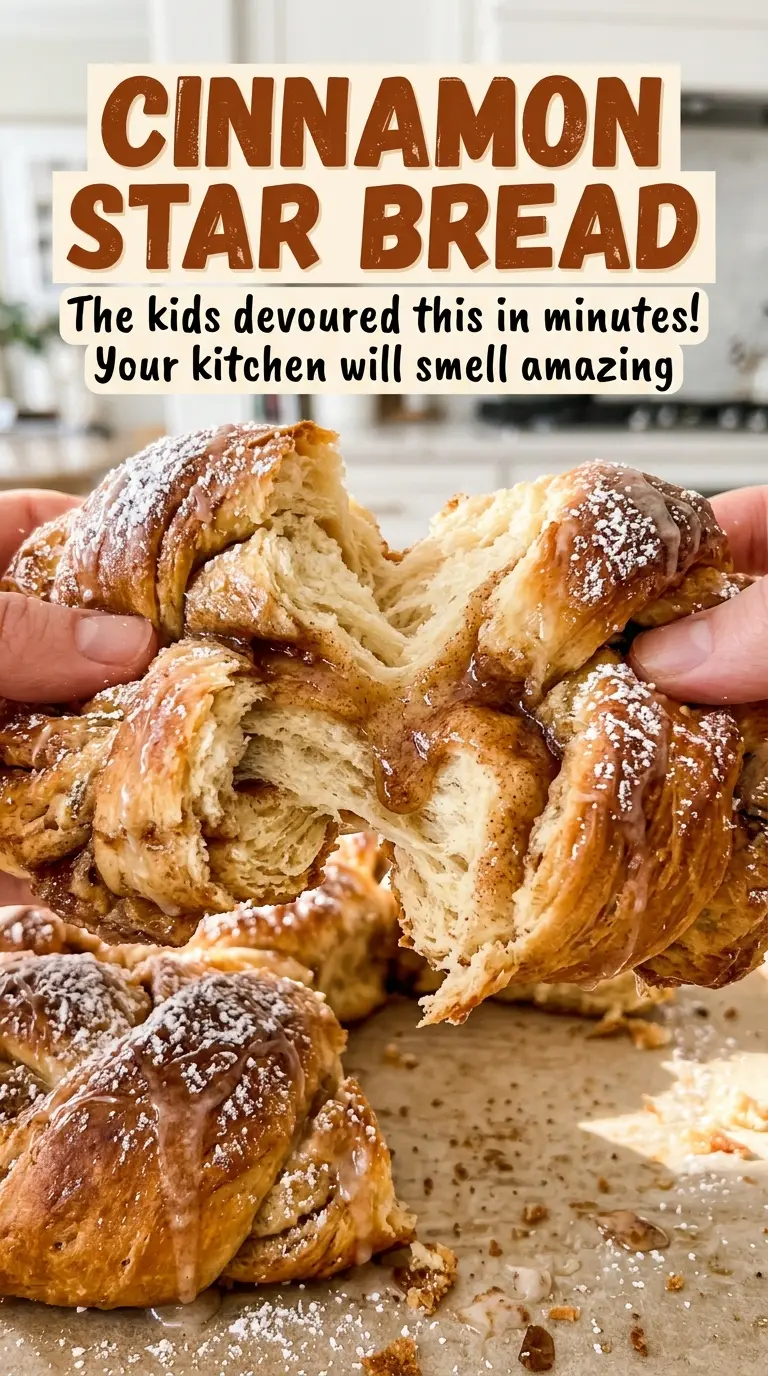
When the star comes out of the oven, the tips are crisp and golden while the middle is still soft enough to pull apart in warm, cinnamon-scented layers. Getting that shape looks more complicated than it is. The part that matters most is keeping the stacked circles joined at the center, so the twists open into points instead of separating into loose strips.
I make this Cinnamon Star Bread with a soft yeast dough and a simple brown sugar-cinnamon filling. The dough gets time to rise, then it’s divided into four portions and layered with softened butter and cinnamon sugar. Once the edges are cut and twisted, the whole thing bakes on one parchment-lined sheet pan. It’s a pretty centerpiece, but the process is manageable if you take the shaping one small section at a time.

Kitchen Note
After dividing the dough, give the portions their full 10-minute rest before rolling. It relaxes the dough, so the circles are easier to shape without pulling back on the counter.
Save this Cinnamon Star Bread for its soft, pull-apart layers and cinnamon-sugar center. The shaping is easier than it looks once the dough is divided.
Why the Star’s Center Has to Stay Joined
The shape depends on one small piece of dough doing a lot of work: the uncut center. You’ll slice the layered round into 16 strips, but stop about half an inch from the middle. That uncut hub holds all the strips in place while you twist them, and it gives the finished bread a clear center instead of a hole.
Think of each pair of neighboring strips as one point. Twist the pair away from each other twice, then pinch the ends together. If you cut all the way through the center, the strips can shift independently and the star is harder to keep symmetrical. If you leave too much uncut dough, the center will look bulky. A small, even hub makes the points easier to shape and keeps the layers connected as they bake.
The bread doesn’t need to look perfectly identical all the way around. Keep the cuts even and pinch each point securely; the dough will puff during its final rise and soften some of the sharp edges into a tender, pull-apart finish.
Why Soft Butter Makes These Cinnamon Layers Work
- Whole milk — It gives the dough richness and helps it bake up tender. Warm it gently to the specified range; milk that’s too hot can interfere with the yeast.
- Active dry yeast — The foamy surface after its short rest is a useful sign that the yeast has started working. If the milk mixture stays flat, don’t build the dough on it; the bread won’t rise as expected.
- All-purpose flour — It makes a soft dough that’s still sturdy enough to roll into circles and twist. Keep the reserved flour for dusting the counter and rolling pin, rather than working extra flour into the dough.
- Unsalted butter — Softened butter kneads into the dough smoothly and spreads across the rolled layers without tearing them. For the filling, it should be soft enough to spread but not melted; melted butter can run toward the edges and make the stacked circles slippery.
- Light brown sugar and cinnamon — The packed brown sugar brings a deeper, slightly caramel-like sweetness than white sugar, while ground cinnamon gives the filling its familiar warm aroma. Break up any brown sugar lumps before sprinkling it over the butter.
- Egg wash — Brushing the beaten egg and water over the shaped bread helps the top bake to a glossy golden finish. Use a light, even coat so it doesn’t pool in the center.
From Yeast Foam to a Golden, Twisted Star
Wake the yeast and bring the dough together
Warm the milk to 105–110°F, then whisk in the active dry yeast and granulated sugar. Let it stand for 5–10 minutes, until a foamy layer forms on top. Whisk in the egg, then add 2 7/8 cups of the flour and the salt; mix until you have a shaggy dough. If the yeast mixture hasn’t foamed, pause here rather than moving on with inactive yeast.
Knead until smooth, then let the dough rise
Knead in the softened butter a tablespoon at a time, letting each addition work into the dough before adding the next. Continue kneading for 8–10 minutes, until the dough feels smooth and elastic rather than rough or sticky. Cover the bowl and leave it in a warm place for 1–1 1/2 hours, until doubled in size. A cool room can slow the rise, so use the doubled size—not the clock alone—as your cue.
Stack the cinnamon-sugar circles
Stir together the brown sugar and cinnamon, then gently press the air out of the risen dough and divide it into four equal portions. Cover the portions and let them rest for 10 minutes while you line a 13×18-inch rimmed baking sheet with parchment paper. Roll one portion into a 10-inch circle using the reserved flour to dust the work surface and rolling pin, then transfer it to the sheet. Spread one-third of the softened filling butter over the circle, leaving a 1/2-inch border, and scatter on one-third of the cinnamon sugar; stack and fill the next two circles the same way, then top with the final plain circle.
Cut, twist, and pinch the points
Cut the stacked dough into 16 strips, stopping about 1/2 inch from the center so the circle stays joined. Take adjacent strips in pairs, twist each pair away from each other twice, and pinch the ends together to form eight points. Work around the bread in order and keep the center intact; if a point starts to loosen, pinch its ends together again. Cover the shaped bread loosely and let it rise for 20–30 minutes, until slightly puffy.
Brush and bake until the middle is set
Preheat the oven to 350°F while the shaped bread rises. Beat the egg with the water and brush it over the top in a thin, even layer. Bake for 25–30 minutes, until the bread is golden brown and the center layers are baked through; a deeply browned outside alone isn’t enough if the middle still looks doughy. Let it rest on the baking sheet for 10 minutes before serving.
Two Ways to Change the Cinnamon Star
Add orange zest to the filling
For a citrus note, finely grate orange zest into the brown sugar and cinnamon before layering. The bread keeps its cinnamon warmth, with a brighter aroma; use only the colored zest and avoid the bitter white pith.
Make it dairy-free
Replace the whole milk with an equal amount of unsweetened oat milk, and use dairy-free butter in both the dough and filling. The bread will still form soft layers, though the buttery flavor will be less rich. Keep the egg in the dough and egg wash; this change is dairy-free, not egg-free.
Storage and Reheating
- Refrigerator: Keep leftovers covered for up to 3 days; the bread will firm up faster in the fridge than at room temperature.
- Freezer: Freeze fully cooled bread, wrapped tightly, for up to 2 months. Thaw it while still wrapped so the surface doesn’t dry out.
- Reheating: Warm pieces in a 300°F oven until soft and heated through. Avoid extended microwave heating, which can make the bread tough as it cools.
Questions That Come Up While Shaping Star Bread
Cinnamon Star Bread
Ingredients
Equipment
Method
- Warm the milk to 105–110°F.
- Whisk the yeast and granulated sugar into the warm milk and let stand for 5–10 minutes, until foamy.
- Whisk in the egg, then add 2 7/8 cups of the flour and the salt; mix until a shaggy dough forms.
- Knead in the softened butter, a tablespoon at a time, then knead for 8–10 minutes, until the dough is smooth and elastic.
- Cover the bowl and let the dough rise in a warm place for 1–1 1/2 hours, until doubled in size.
- Stir the brown sugar and cinnamon together in a small bowl.
- Gently press the air out of the dough and divide it into 4 equal portions.
- Cover the dough portions and let rest for 10 minutes.
- Line a 13x18-inch rimmed baking sheet with parchment paper.
- Dust the work surface and rolling pin with the reserved 2 tablespoons flour, roll one portion into a 10-inch circle, and place it on the baking sheet.
- Spread one-third of the softened butter over the dough, leaving a 1/2-inch border, and sprinkle with one-third of the cinnamon-sugar mixture.
- Roll each of the next two portions into a 10-inch circle, stack them one at a time, and spread each with one-third of the remaining butter and cinnamon-sugar mixture; roll the final portion into a circle and place it on top without filling.
- Cut the stacked dough into 16 strips, stopping about 1/2 inch from the center so the strips remain joined.
- Twist each pair of adjacent strips away from each other twice, then pinch their ends together to form 8 points.
- Preheat the oven to 350°F.
- Cover the shaped bread loosely and let rise for 20–30 minutes, until slightly puffy.
- Beat the egg with the water and brush the mixture over the top of the bread.
- Bake for 25–30 minutes, until the bread is golden brown and the center layers are baked through.
- Let the bread rest on the baking sheet for 10 minutes before serving.