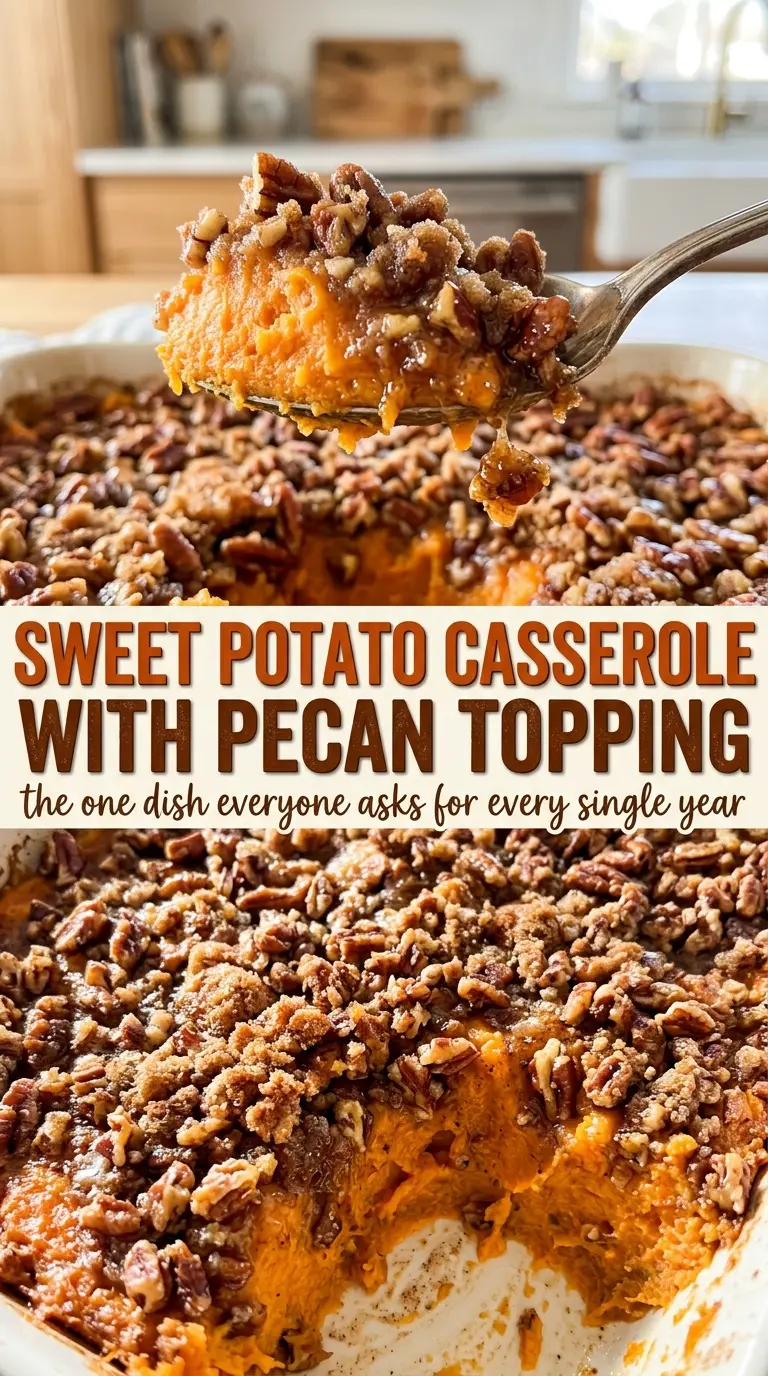
A sweet potato can look soft on the outside and still resist a knife at its thickest point. I check there before taking the pan out of the oven; fully tender potatoes mash easily and make a smoother base for this Sweet Potato Casserole with Pecan Topping. The filling has enough sweetness from the potatoes and a little granulated sugar, while the pecan crumble gives each scoop a crisp, buttery top.
I let the roasted potatoes cool enough to handle, peel them, and mash them while they’re still warm. Then I wait until the mash is warm rather than hot before stirring in the eggs and the rest of the filling ingredients. That small pause keeps the mixture easy to combine, without steaming the eggs as they go in.
Once the filling is spread into the baking dish, the topping bakes into golden clusters over a soft, rich center. A short rest after baking helps the casserole settle, so it scoops neatly instead of running across the plate.

Kitchen Note
Keep the butter for the crumble cold until you work it into the flour, sugar, and pecans. Stop when you have uneven clumps; if the mixture turns into a smooth paste, the topping won’t bake up in those distinct crunchy clusters.
Save this pecan-topped sweet potato casserole for its soft, buttery filling and golden clusters of crunch.
Why This Casserole Starts With Whole-Roasted Sweet Potatoes, Not Boiled Ones
Sweet potatoes already hold plenty of moisture. Roasting them whole on a baking sheet cooks the flesh until it’s tender without leaving water clinging to it, as can happen when potatoes are boiled and drained. That matters in a casserole: excess water can leave the filling loose instead of soft and spoonable. Roasting also gives the potatoes time to develop a deeper, naturally sweet flavor before they meet the butter, milk, and eggs.
Let the knife test guide you rather than the clock alone. The 45-to-60-minute range accounts for differences in potato size and shape, so check the thickest part of each potato. If the knife still meets resistance, give them more time; a firm center won’t mash evenly with the softer edges. Once every potato is tender, the rest of the filling comes together without needing extra liquid or a separate draining step. The result is a casserole base that holds its shape under the pecan topping while staying creamy when you scoop it.
What Each Part of the Pecan Topping Brings to the Dish
- Sweet potatoes — Choose firm potatoes without soft spots. Similar-sized potatoes tend to finish roasting at a similar pace, though the knife test matters more than appearance. Fresh sweet potatoes give the filling its body and sweetness; canned ones can bring extra moisture and a softer texture.
- Unsalted butter — Using unsalted butter lets the kosher salt season the filling without making the overall salt level harder to control. The melted portion enriches the mash, while the cold portion helps form clumps in the topping. Butter quality is noticeable here, but a standard grocery-store unsalted butter works well.
- Whole milk and eggs — Whole milk loosens the mash while keeping it rich, and the eggs help the filling set as it bakes. Use fresh eggs and stir them in only after the mash has cooled to warm; there’s no need for a specialty brand.
- Vanilla extract — Vanilla rounds out the sweet potato flavor without making the filling taste like dessert custard. Pure vanilla is lovely, but ordinary vanilla extract works too.
- Flour and light brown sugar — Flour gives the topping structure, while packed light brown sugar adds sweetness and helps the crumble turn golden. Fresh, soft brown sugar mixes into clumps more easily than sugar that has dried into a hard lump.
- Pecans — Chopped pecans bring the topping’s toasted, nutty crunch. Buy them from a shop with good turnover if you can; stale pecans can taste bitter, while a basic bag of fresh chopped pecans is perfectly suitable.
From Whole Sweet Potatoes to a Set, Golden 9×13 Casserole
Roast Until the Thickest Part Is Tender
Heat the oven to 400°F. Prick the sweet potatoes all over with a fork and set them on a rimmed baking sheet, leaving room around them. Roast for 45 to 60 minutes, checking the thickest part with a knife. They’re ready when the knife slides in easily; if it catches, keep roasting and check again.
Mash and Let the Heat Ease Off
Let the potatoes cool for about 15 minutes, until they’re easy to handle. Peel them, place the flesh in a large bowl, and mash until there are no large pieces left. Give the mash time to cool until it’s warm, not hot, before adding the eggs. If it’s still steaming, wait a little longer rather than rushing the next step.
Mix the Filling and Make the Crumble
Stir the melted butter, granulated sugar, milk, eggs, vanilla, and kosher salt into the mash until evenly combined. Reduce the oven to 350°F and grease a 9×13-inch baking dish. In a separate medium bowl, mix the flour, brown sugar, and chopped pecans, then work in the cold butter with your fingers until clumps form. The crumble should stay uneven rather than becoming a uniform paste.
Bake Until the Center Sets
Spread the sweet potato mixture evenly in the prepared dish and scatter the topping over it. Bake for 30 to 35 minutes, until the pecan topping is golden and the center registers 160°F on an instant-read thermometer. If the top looks ready before the center reaches that temperature, use the thermometer reading to guide you. Let the casserole rest for 10 minutes before serving.
Three Useful Ways to Adapt This Pecan-Topped Casserole
Make It Dairy-Free
Use dairy-free butter in both the filling and topping, and replace the whole milk with the same amount of unsweetened plain oat milk. The filling stays creamy, though the topping may brown a little differently depending on the butter alternative; check its color as it bakes.
Use a Gluten-Free Crumble
Replace the all-purpose flour with a cup-for-cup gluten-free flour blend. Keep the other topping ingredients and method the same. The crumble may be a touch more delicate, but it still bakes into clusters over the filling.
Leave Out the Pecans
For a nut-free topping, omit the pecans and keep the flour, brown sugar, and butter. You’ll lose the nutty crunch, but the remaining crumble still forms a sweet, buttery layer over the casserole.
Storage and Reheating
- Refrigerator: Cover leftovers and refrigerate within 2 hours; they keep for 3 to 4 days. The topping softens as it sits.
- Freezer: Freeze cooled portions in an airtight container for up to 2 to 3 months for best quality. Thaw overnight in the refrigerator; the topping will be less crisp after freezing.
- Reheating: Reheat covered in a 325°F oven until the center reaches 165°F, uncovering near the end if you want to dry the topping slightly. A microwave works for individual portions, but it softens the crumble further.
Questions That Come Up While Baking Sweet Potato Casserole
Sweet Potato Casserole with Pecan Topping
Ingredients
Equipment
Method
- Preheat the oven to 400°F.
- Prick the sweet potatoes all over with a fork and set them on a rimmed baking sheet. Roast for 45 to 60 minutes, until a knife slides easily into the thickest part.
- Let the potatoes cool until easy to handle, about 15 minutes.
- Peel and mash the potatoes in a large bowl, then let the mash cool until warm, not hot.
- Stir in 1/2 cup melted butter, the granulated sugar, milk, eggs, vanilla, and salt until evenly combined.
- Reduce the oven temperature to 350°F.
- Grease a 9x13-inch baking dish.
- In a medium bowl, mix the flour, brown sugar, and pecans.
- Work in the remaining 1/2 cup cold butter with your fingers until clumps form.
- Spread the sweet potato mixture in the prepared baking dish and sprinkle the topping evenly over it.
- Bake for 30 to 35 minutes, until the topping is golden and the center registers 160°F on an instant-read thermometer.
- Let the casserole rest for 10 minutes before serving.